



Table of Contents
Introduction: The Debate That Changed How We Speak 
As a strategic communication expert who has trained countless leaders, watching the multiple 2024 U.S. presidential debates and what played out on stage wasn’t just politics — it was a live demonstration of shifting human psychology and evolving communication strategies.
We are living in an era where people are saturated with information, emotionally dispersed, and constantly distracted. This has radically altered how leaders must connect with their audiences. In today’s world, leadership communication must cut through the noise — not with volume, but with precision, emotional clarity, timing, and most importantly deliberate and strategic body language and tone of voice.
This chapter offers thirteen key insights from those debates — not to glorify political figures, but to extract real, teachable strategies for anyone serious about leading with impact through the power of communication.
It’s the Listener, Not the Speaker 
One of the most overlooked principles in leadership communication is that the true focus should be on the listener, not the speaker. Many leaders become absorbed in refining their message but forget to consider how that message will actually be received. Effective communicators are attuned to their audience’s emotional and cognitive state. They speak not just to their audience but from within the listener’s frame of reference. When communication is customized to the emotional tone, language, and lived experience of the audience, it lands powerfully and creates connection.
The Pull of Negative Communication 
Negativity, for better or worse, has a visceral effect on human attention. Studies show that the human brain is wired to respond more quickly to negative cues than to positive ones. In leadership communication, this means that while fear-based or victim-oriented messaging may generate quick engagement, it can also be polarizing or damaging if used irresponsibly. Leaders must understand this psychological pull and wield it carefully. Emotional honesty must never become emotional manipulation, although this is mostly no longer the case.
Communication Reflects Leadership Capacity 
More than any credential or experience, people judge a leader by how they communicate. In fact, communication is often the first filter through which people assess leadership ability. This means that mastering leadership communication is not optional — it’s essential. Your tone, body language, timing, and emotional congruence create the invisible thread between you and those you seek to lead. If your communication is off, your credibility, authority, and influence will suffer — no matter how capable you are behind the scenes and how good you are at explaining. People are moved by E-motion not endless explanatory language. .
Appealing to the Victim Mindset 
We live in an era where many people feel disempowered, unheard, or even betrayed by large systems and institutions. Messages that tap into this sense of “us versus them” — the underdog narrative — tend to resonate with large portions of the population. In leadership communication, it’s important to understand this dynamic without exploiting it. Empathy is powerful when it bridges the gap between struggle and empowerment. Great leaders speak to the wounds of their audience, but they don’t leave them in pain. They offer a path forward, if they are genuine and that is a big “if”.
The Danger and Power of Repetition 
Repetition is a double-edged sword. On one hand, it builds familiarity and embeds messages in the mind. On the other hand, it can be used to manipulate or distort truth. The 2024 debates revealed how repeating even unverified or false statements can shape perception over time. Leadership communication must embrace the power of repetition — but use it ethically. By consistently reinforcing values, vision, and key principles, leaders can shape culture without sacrificing integrity.
Divide and Conquer: A Cautionary Method 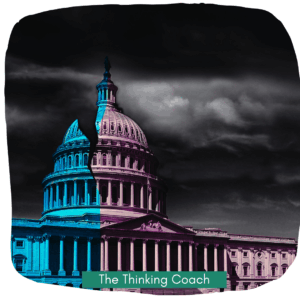
One of the darker tactics revealed during the debates was the method of “divide and conquer.” By planting seeds of doubt and attacking opponents personally, communicators can fragment group cohesion and weaken critical thinking. In the realm of leadership communication, this approach creates short-term wins but long-term distrust. Leaders who seek to unify must communicate in ways that restore coherence, build bridges, and reduce confusion — not feed it.
The “Change” Trigger 
Nothing captures attention like the promise of change. The human brain is naturally drawn to novelty and improvement. In the debates, Trump’s message — regardless of content — felt different, which gave it emotional leverage. Leaders must understand that leadership communication is not just about delivering facts — it’s about embodying what your audience longs for. When your communication style reflects freshness, boldness, and hope, people become more receptive to the substance beneath your message.
Emotion Over Information 
In any decision-making process, emotion precedes logic. People don’t just evaluate data — they feel their way toward choices. This is especially true in leadership communication. While leaders must be factually accurate and intellectually credible, they must also understand that facts don’t move people — E-motions do. To lead effectively, communicate through emotion, then justify with reason. Emotional resonance is the gateway to action.
Hope as an Emotional Driver 
A message that inspires hope can galvanize people. Hope is one of the most enduring emotional currencies in leadership communication. When leaders can ignite a sense of possibility, people become more resilient, more engaged, and more willing to take risks. Offering hope doesn’t require false promises — it requires authentic vision, emotional warmth, and the courage to believe out loud.
The Three Levels of Communication 
Effective communication is never just verbal. It operates on three simultaneous levels: words, body language, and tone of voice. The most impactful leadership communication happens when all three channels align. This creates a whole-brain experience for the listener, activating both the logical and emotional centers of the brain. When your body says what your mouth says — and your tone backs it up — people don’t just understand you. They trust you…infact THEY GET YOU!
Speak Boldly and Simply 
In an age of noise and complexity, simplicity is power. Messages that are too intellectual or jargon-heavy often fail to connect with broader audiences. Great leadership communication is marked by bold, clear, emotionally grounded language that reaches people quickly and memorably. Don’t aim to impress. Aim to express. A single well-crafted phrase can carry more leadership weight than a thousand well-researched slides.
One-to-One Intimacy in Crowd Communication 
Whether speaking to five people or five thousand, leaders must learn to make each person feel seen. The secret to mass communication is intimacy — speaking as if it’s a personal conversation. In effective leadership communication, the crowd becomes a collection of individuals, and your message feels personal to each one. Leaders who master this tone foster deep loyalty and trust.
It’s What’s Behind the Words 
At the core of leadership communication is authenticity. People don’t just hear your words — they feel your intention. If your message is misaligned with your energy or values, people will instinctively pull away. What matters isn’t just who’s speaking — it’s what’s speaking through you. Great communicators speak from a place of internal alignment, which resonates as truth. And in today’s world, truth is magnetic.
Your Next Step: Master Leadership Communication That Resonates
If this chapter revealed how much depth, strategy, and emotional intelligence go into leadership communication, then the next step is yours to take. 
Through transformational seminars, custom workshops, and executive coaching, Eli Harari — The Thinking Coach™ — helps leaders and professionals at every level:
- Master the psychology of how people truly listen and respond
- Communicate with clarity, authenticity, and emotional precision
- Build trust quickly with teams, clients, and stakeholders
- Refine their verbal and nonverbal delivery for maximum impact
- Turn communication into a leadership advantage — not a liability
This is not about tips and tricks.
This is about becoming the kind of communicator people trust, follow, and remember.
Stop performing. Start resonating.
Don’t just lead the room — move the room.
Book your session, training, or workshop with The Thinking Coach™ today.
Let your voice become a powerful tool for change, clarity, and connection.